Invalidation — where a count is wrong
Every lesson so far in this module has pointed toward this one, because invalidation is the idea that makes everything else honest. A wave count that can never be proven wrong isn't an analytical read — it's a story that gets reinterpreted after the fact to fit whatever happened. Invalidation is the deliberate opposite of that: stating, in advance, the specific price level or condition that would mean the current read is incorrect, before the market has a chance to decide the answer.
What invalidation actually is
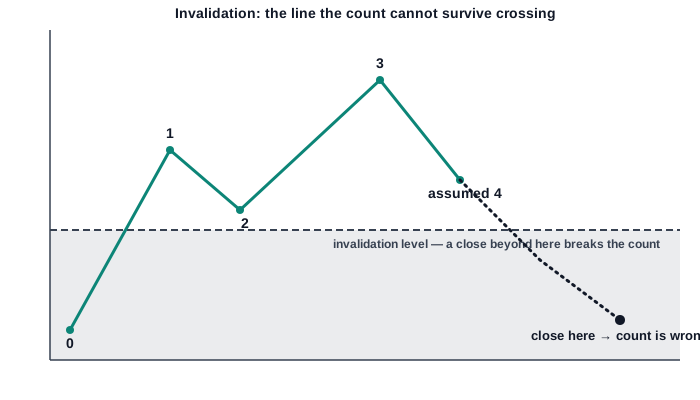
An invalidation level comes directly out of the structural rules a wave count depends on. If a count requires wave 4 to stay above wave 1's territory (lesson 3), then a close inside wave 1's territory is that count's invalidation level — not a vague "if things go badly," but a specific, pre-stated line. If a count requires wave B of a zigzag to stay within the start of wave A (lesson 4), a close beyond that start is the invalidation. The level isn't chosen for convenience after the fact; it falls directly out of whichever rule the current count is leaning on hardest.
Why "a close beyond" and not "a touch beyond"
Wicks happen. Price frequently pokes through a level intraday and pulls back without ever settling there — a stop run, a liquidity grab, ordinary noise on a lower timeframe. Treating every wick through a line as invalidation makes a count flicker in and out of validity constantly, which isn't useful. The more disciplined convention is to require a *close* beyond the level, on the timeframe the count is being tracked on, before treating the count as broken. That single convention — wick doesn't count, close does — removes a large fraction of the false alarms that make wave counting feel unreliable to people who haven't settled on a consistent rule for it.
Every count needs one before it needs anything else
The sequencing matters here. The moment a wave count is proposed — this is wave 3 of an impulse, this is wave B of a flat, whatever it is — the first follow-up question should be "what would prove this wrong," answered with an actual level, not answered later once price has already moved. A count without a stated invalidation isn't incomplete in some minor, fixable way; it's not a serious analytical claim yet. This is also the discipline that keeps wave analysis from sliding into the trap lesson 9 describes at length: forcing price into a preferred narrative regardless of what it's actually doing, because there was never a pre-committed level that could have stopped the narrative in the first place.
Invalidation is not a prediction of failure
It's worth separating two very different things that sound similar: stating an invalidation level, and predicting that price will hit it. Stating the level is simply intellectual honesty about the conditions under which the current read is wrong — it says nothing about how likely that outcome is. A count can carry high confidence and still have an invalidation level; the two aren't in tension. What would be in tension is a count with no answer at all to "what would change your mind" — that's not confidence, it's just an unfalsifiable claim wearing confidence's clothes.
What happens after invalidation
When price closes beyond an invalidation level, the correct response isn't to quietly move the line and pretend the count survived — that's the single fastest way to turn a useful analytical tool into a rationalization engine. The correct response is to treat the prior count as dead and ask what the price action actually is now, starting fresh from the structural rules in the lessons behind this one. Sometimes that means the move that invalidated a bullish count turns out to be the start of an entirely different structure; sometimes it means the larger-degree count from lesson 5 was fine all along and only the smaller-degree labeling needed revision. Either way, an invalidated count updating cleanly into a new one is the system working as intended, not a failure of it.
What would invalidate this read
This lesson is, in a sense, entirely about answering that question for every other lesson in the module — but applied to itself: the claim here is that a stated, pre-committed, close-based invalidation level is what separates a checkable wave count from an unfalsifiable one. That claim would be undermined if a wave reader could get equally useful results while treating invalidation levels as optional or movable after the fact. In practice, that's not what happens — a discipline that lets its own boundaries move whenever they're inconvenient stops being a discipline, which is exactly why the next lesson builds a workflow that puts this check at a specific, non-skippable step rather than leaving it to memory.
Comments (0)
- No comments yet.