Fibonacci relationships in waves
The Fibonacci sequence — 1, 1, 2, 3, 5, 8, 13, 21, and so on, each number the sum of the two before it — produces a ratio between consecutive terms that converges to roughly 0.618, and its inverse to roughly 1.618. Those two figures, along with a handful of others derived from the same sequence (0.382, 0.5, 0.786, 1.272, 2.618, among others), show up often enough in the proportions between wave lengths that they've become a standard part of the wave analyst's toolkit. This lesson covers what that means, and — just as importantly — what it doesn't.
Where the ratios tend to show up
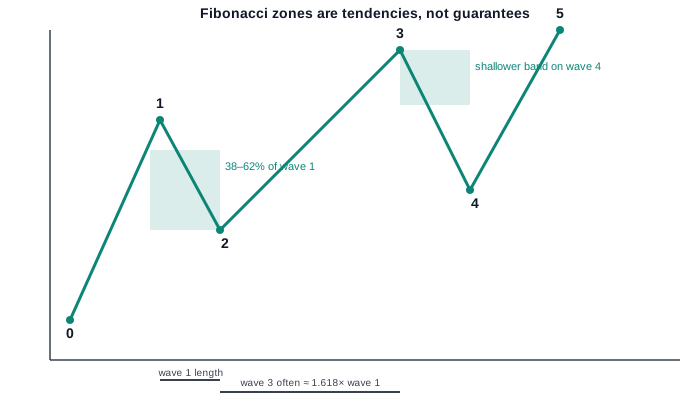
Two relationships come up most often in practice. The first is retracement: how much of a prior wave a following corrective wave gives back. A wave 2 retracing somewhere in the neighborhood of 50% to roughly two-thirds of wave 1 is a common outcome; a wave 4 retracing a shallower slice of wave 3, often in the roughly one-quarter to one-third range, is another. The second relationship is extension: how a motive wave's length compares to another motive wave in the same sequence. Wave 3 running out to something in the neighborhood of 1.618 times the length of wave 1 is a frequently observed proportion, as is wave 5 bearing a similar relationship to the combined length of waves 1 through 3, in certain configurations.
Tendencies, not laws
It's worth stating this as plainly as possible: these are observed tendencies in how waves have historically tended to proportion themselves, not physical constants and not guarantees about any specific wave in progress. A correction that retraces 45% instead of landing neatly on 38.2% or 61.8% hasn't broken any rule — the actual rules were covered in lesson 3, and none of them mention Fibonacci ratios at all. Treating a Fibonacci zone as if it were a hard floor or ceiling, rather than a *zone worth paying extra attention to*, is one of the more common ways a reasonable technique gets misused into something closer to numerology.
Why they're useful anyway
Given how loosely they hold, it's fair to ask why Fibonacci zones are worth tracking at all. The honest answer is that they concentrate attention on a specific, narrow band of prices ahead of time, which is exactly the kind of falsifiable, checkable claim wave analysis is trying to produce throughout this module. A wave reader who says "wave 2 will retrace somewhere in this zone" has made a claim that price can specifically confirm or specifically contradict, at a specific location, before it happens — which is a meaningfully different (and more useful) statement than a vague "it should pull back a bit." Multiple ratios clustering near the same price level — a 61.8% retracement of one wave landing close to, say, a prior swing's low — is often treated as a stronger zone precisely because more than one independent measurement agrees on it, not because either measurement is individually more reliable than usual.
The failure mode to watch for
The most common misuse isn't calculating a ratio wrong; it's *reverse-engineering* one — starting from a price level you already like for some other reason, then hunting through enough Fibonacci combinations until you find one that happens to land there, and treating that coincidence as confirmation. Because there are many possible ratios and many possible starting/ending points to measure from, this kind of search will always eventually "succeed," which makes it worthless as evidence. The discipline is to fix the two points you're measuring from before you know what the ratio will say, not after.
What would invalidate this read
Fibonacci zones don't get "invalidated" in the same binary sense as the structural rules in lesson 3 and lesson 7 — a retracement running a bit outside a zone doesn't kill a wave count on its own, since the zones are guidelines. What they do is downgrade confidence: a wave 2 that blows straight through the 61.8% zone without much hesitation and keeps going is behaving less like a typical wave 2, and that's a reason to weight the structural rules and the alternative counts a little more heavily going forward, even before any hard rule is actually broken. Fibonacci relationships are best read as an early-warning layer sitting on top of the real invalidation logic, not a replacement for it.
Comments (0)
- No comments yet.