Corrections: zigzag, flat, triangle
If motive waves were the only shape on a chart, wave counting would be easy and largely useless — real charts spend a surprising amount of time correcting, not trending, and a wave reader who can only recognize impulses is blind for a large fraction of any chart's life. Corrections take three common families of shape, and telling them apart is less about memorizing labels and more about reading what each shape says about the crowd's underlying reluctance to let go of the prior move.
*A related lesson elsewhere in this library, Corrective wave patterns, works through the same three families from the course's original notes in more rule-by-rule detail — worth reading alongside this lesson rather than instead of it; the two are complementary, not duplicates.*
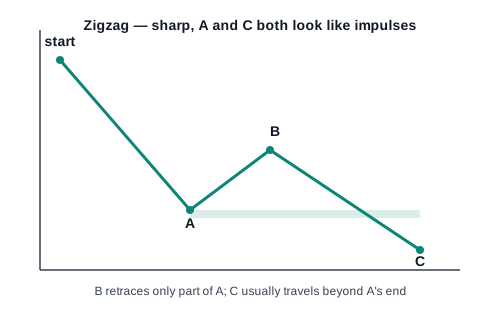
Zigzag: sharp and decisive
A zigzag is the simplest corrective shape: three legs, A-B-C, where A and C both subdivide as motive-looking moves against the trend and B is a partial, limited bounce back in the trend's direction. The defining feel of a zigzag is that it looks purposeful — B doesn't retrace very far back toward where A started, and C typically travels beyond A's low, so the whole structure has a sharp, one-sided character. A zigzag reads as a crowd that wants the correction over quickly: doubt shows up hard in A, a brief round of buy-the-dip hope in B, then doubt reasserts itself and pushes through in C.
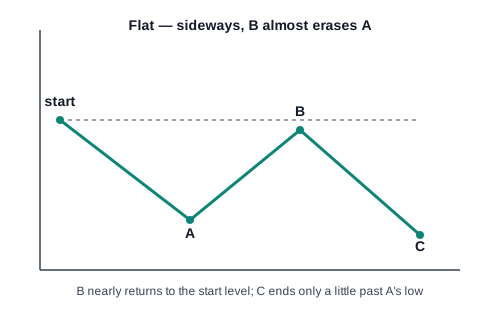
Flat: sideways and reluctant
A flat is also three legs, A-B-C, but the proportions are almost inverted from a zigzag's. B retraces most or nearly all of A — often close to fully — before C makes only a modest further move beyond A's extreme. Visually, a flat looks like sideways churn rather than a decisive move in either direction. That shape says something different about the crowd than a zigzag does: the initial move (A) didn't attract the conviction a zigzag's A does, the bounce back (B) recovers most of the ground, and the final leg (C) is more of a formality than a decisive push. Flats often show up when the larger trend is strong enough that the market isn't willing to give back much ground even during a "correction."
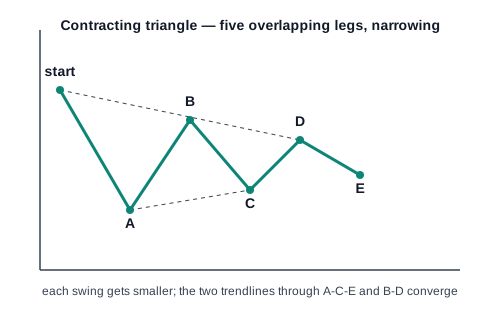
Triangle: contracting, patient, sideways
A triangle is a five-legged corrective shape, A-B-C-D-E, where each leg is progressively smaller than the one two legs before it, so the whole structure narrows — trendlines drawn through A-C-E and B-D visibly converge. Where a zigzag reads as decisive and a flat reads as reluctant, a triangle reads as exhausted: neither side of the crowd has enough conviction to push price meaningfully further, so the range simply contracts as participation drains out of the correction. Triangles have an odd reputation for showing up specifically in the wave-4 position of a larger impulse and for often preceding a fast, sharp move once they finally resolve — the contraction itself building the kind of pent-up pressure that a narrowing range tends to release quickly.
Combinations
Real charts sometimes give you a correction that doesn't cleanly resolve as a single zigzag, flat, or triangle, but instead runs two or three of those simpler corrective shapes back-to-back, joined by a connecting move. This is normal, not a failure of the framework — it just means the correction needed more time and more back-and-forth to fully digest the prior move than any single simple shape could express. Treat a combination as a signal that the correction is more drawn-out than usual, not as license to force an early resolution onto price that hasn't actually resolved yet.
Telling them apart in practice
The single most useful habit is comparing wave B against wave A as soon as both exist: a shallow B (well under half of A) leans zigzag; a deep B (close to or beyond the full length of A) leans flat; and a B that looks like its own small motive/corrective mix rather than a clean single swing is often the first leg of a developing triangle. None of these are guarantees this early — a shape can still develop into something else as more of it prints — but they're a genuinely useful first read rather than a coin flip.
What would invalidate this read
Each corrective shape carries its own version of a wrong-count signal. A supposed zigzag where B actually exceeds the start of A isn't a zigzag anymore — B has gone too far, and the correction needs relabeling, possibly as a flat variant. A supposed flat where C fails to move meaningfully beyond A at all can be signaling something closer to a triangle instead. And a supposed triangle where one leg suddenly breaks decisively outside the converging trendlines has stopped contracting — the correction has resolved (or the whole triangle read has failed), and the next question is which motive or corrective shape actually comes next. In every case, the check is the same: does the shape as printed still match the definition, or has price already told you to relabel it.
Comments (0)
- No comments yet.